

The life of journalist, author, and educator Wallace Terry (1938-2003) is chronicled in fascinating detail by historian Ray E. Boomhower in the new biography Wallace Terry: A Reporter’s Journey from Selma to Saigon to Bloods.
Terry was described in an obituary written by Martin Weil in The Washington Post as “a pioneering black journalist and author who covered the civil rights movement and the Vietnam War,” and noted his early career at the Post, followed by Time magazine, where he was a war correspondent, among other assignments.
Boomhower is a prolific author and a senior editor at the Indiana Historical Society Press. In the book, he discusses the multidisciplinary nature of Terry’s life and career, and how it unfolded during the complexities of the second half of the 20th century, politically and culturally.
I am grateful to Ray for answering my questions about his work on the biography (published by the High Road Books imprint of University of New Mexico Press), the motivation and resilience of Wallace Terry, and what Terry’s ambitions were in the time period leading up to his death.
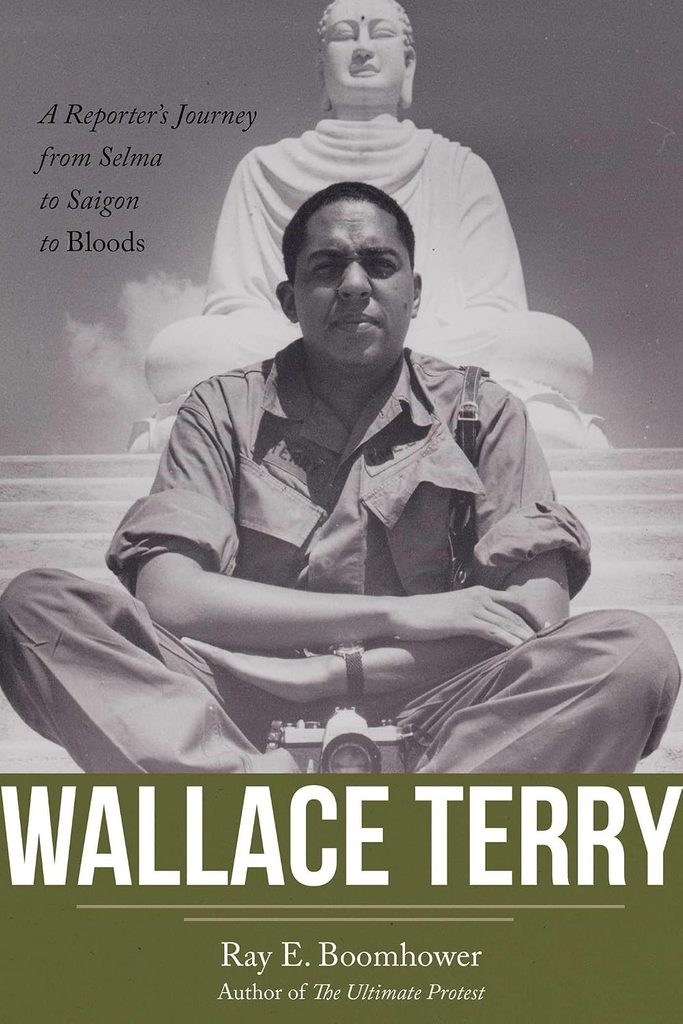
In terms of choosing the project, researching, and writing; how similar or different was the process for Wallace Terry: A Reporter’s Journey from Selma to Saigon to Bloods?
The process for choosing, researching, and writing Wallace Terry’s biography closely followed the pattern I had undertaken for my previous two biographies (Richard Tregaskis and Malcolm Browne), both of whom were also war correspondents. I like to think of my Terry book as completing my war correspondent trilogy.
Also, with Terry, as I did for Tregaskis and Browne, I was in contact with the widows of each man. Janice Terry was particularly helpful, answering any question that cropped up during my research and writing. She also provided a keen editorial eye on the final manuscript, catching grammar mistakes and factual errors. I could not have done it without her, as well as Terry’s son David and daughter Lisa.
In any biographical project I undertake, I always try to find personal connections that will sustain me through the years it takes to get a book completed. I discovered that the biographer and his subject shared some obvious connections with the Terry biography, including both of us being children of divorce. We both grew up in Indiana and had dabbled in sports in school (Terry in football, me in tennis) before wholeheartedly embracing journalism as editors of our high school newspapers.
We continued to follow journalism as a path in college, with Terry breaking barriers by becoming the first Black editor of an Ivy League school newspaper while at Brown University. We both dreamed of having our names emblazoned on the cover of a book.
I took additional encouragement from the fact that Terry and I shared admiration for another great Hoosier war correspondent, Ernie Pyle, about whom I had written many times, including a youth biography. Terry took inspiration from Pyle’s war writing, remembering, “I thought there was no one like Ernie Pyle, except maybe Ernest Hemingway and Stephen Crane. Those writers had the greatest influence on my own writing.”
My feeling from reading your book is that Terry was driven by a combination of professional/personal ambition and a sense of a religious/spiritual/ethical calling. Does that have merit?
It is hard to divorce the drive for success Terry needed to have to succeed as a Black man in a white-dominated field, as the media remains today, with his religious training as an ordained minister in the Disciples of Christ. The life of a minister, however, was not strong enough, finally, to lure him away from his true calling—journalism.
There was a time in putting together questions to the subjects for his classic oral history Bloods when it seemed that Terry had forgotten his former calling. Janice noticed that her husband had no queries dealing with the veterans’ feelings about God, asking him, he recalled, “What kind of minister are you?” What kind of writer, he realized, would not think of dealing with faith and God when discussing a soldier’s war experience?
With Janice’s assistance, Terry wrote additional questions to address the subject. A writer without a religious background, he realized, would probably have left out those kinds of questions. “But in my case the religious background was there and I was still about to blow it,” he added. “Fortunately, I had a wife who is a partner and editor as well. Everybody needs editing, needs a sounding board.”
Terry died tragically of a rare form of vascular disease at 65. Do you think he felt professionally fulfilled at that point, and was he planning to continue working at his various pursuits indefinitely?
With the release of Bloods in 1984, Terry felt he had accomplished what he had always wanted to do as a journalist—make people understand that there was nothing about the Black experience that was not “first and foremost human and universal. If we understand that, we can live with each other in a much better way.”
He took inspiration from his book’s success to serve as the springboard for a wide range of literary projects that promised to keep him busy, and financially secure, Terry believed, for years to come. He saw Bloods as part of a trilogy that would highlight the bravery and brotherhood displayed by Black and white troops during the war.
Terry wanted to do another oral history book, to be titled “Heroic Hearts: How Martin Luther King’s Dream Came True On the Battlefields of Vietnam.” For volume three in the Bloods trilogy, Terry intended to write a memoir, titled “Correspondent.” He sought to portray his odyssey from the Hoosier heartland to the Ivy League, as well as his pioneering experiences as a Black reporter covering the civil rights movement and the Vietnam War.
Unfortunately, Terry’s death on May 29, 2003, put an end to his ambitious plans. Blood tests disclosed that Terry had been suffering from a rare, undiagnosed illness, Wegner’s granulomatosis (known today as Granulomatosis with polyangiitis), a chronic autoimmune disorder that causes inflammation of blood vessels.