
In June 2024, I interviewed poet and American University literature professor David Keplinger, two months after he moderated a panel discussion, Do I Need an MFA?, at the Barrelhouse writers conference, Conversations & Connections: Practical Advice on Writing. The conference was held in Washington, D.C., at AU, my alma mater.
One of the panelists was the essayist and fiction author Andrew Bertaina, a lecturer in the College of Arts & Sciences at AU, and a graduate of the MFA program. In an endorsement for Andrew’s story collection “One Person Away From You,” Keplinger writes that “Bertaina’s work continues in the tradition of Hemingway’s ‘A Very Short Story’ from In Our Time, but with a fabulist lens, and with a contemporary edge that incorporates Tinder, middle class life, Cosmopolitan, and the movies into the fairy tale. I am so moved by this work, its intelligence and range, which is rivaled only by the tenderness and poignancy of the writing.”
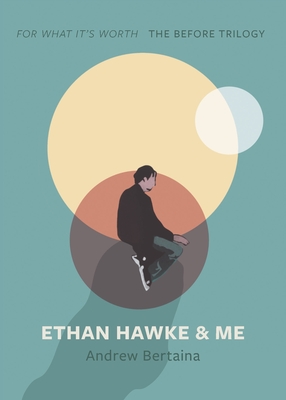
I’ve stayed in touch with Andrew virtually since that 2024 panel, and saw him at the 2025 Barrelhouse conference, reading from his new “hybrid memoir” Ethan Hawke & Me (a book length essay published by Barrelhouse), and the following month at the 2025 Washington Writers Conference.
I’m grateful to Andrew for answering my questions about his multifaceted career as a writer, educator, and a key member of the Washington literary community.
For the non-specialist reader, can you describe the nature of your day-to-day and week-to-week work as a writer, and teacher; including any activities related to writing and teaching, such as presentations or literary readings?
My day to day life is profoundly influenced by my children. I have four of them, so I’m often shuttling teens to activities, coaching their sports teams or picking them up from school. Realistically, this takes up a lot of my free time, so I don’t actually write during the semester.
Most of my time is spent reading and critiquing the work of my students or preparing for class by reading books and preparing discussion questions or meeting individually with students. I really enjoy it, but it’s also a pretty intensive job. When I’m on, I’m one hundred percent on.
I do also run a literary reading series in DC, the 804 Lit Salon, which has been going for the last two and a half years. We host 5-6 readers in our home to a crowd of 35-55 people or so. It’s been a great way to get to know and appreciate people in our writing community. Sometimes writers get a bad rap, but I’ve been truly blessed to get to know my students and the greater DC writing community.
Can you provide a sense of how you approach teaching; inside and outside the classroom, in the MFA program at American University, and if and how that is influenced by having graduated from the program years ago?
I see my role as a teacher as being about improving the baseline of every student who comes into my classroom. I consider it my job to encourage writers where they are at and push them to get better. It’s a delicate balance, but I truly see it as a responsibility to try and improve student writing and thinking in my courses.
I did graduate from the program, but it was a long time ago, 2009, so I don’t know that it impacts me much. The workshop model itself has undergone changes along with the program. Outside of the classroom I like to try and champion or encourage the work of writers who show promise or interest. We’re in a culture that is becoming less and less interested in reading, so I truly see it as part of my job to nurture the small flame of literature with my students.
In an interview several years ago, you stated that your “stories are investigations of time, memory, and loss.” In the same interview, you showed appreciation for Jorge Luis Borges, whom I have extensively written about. Time, memory, and loss are recurring Borges themes, and he, like you, concentrated on essays and short stories (as well as poetry, and teaching). Can you expand a bit on Borges’ influence on you as a writer, and perhaps as a teacher?
I never try to hide the profound influence the other writers have on my own writing and thinking, and I think it definitely applies to the work of Jorge Luis Borges. I read the recent books that came out, Collected Fictions and Selected Non-Fictions. In short, I read his work for around 1,500 pages, and I think the primary way that Borges influenced my writing was his erudition coupled with his playfulness. I feel that Borges manages to thread the needle of being quite an intellectual writer while still maintaining a sense of fun across his stories. It particularly inspired me when it came to essay writing where I almost always prioritize the associative or movement oriented over the pragmatic or linear.
As I said, it’s hard to read so much of anyone’s body of thought and not be influenced by their way of writing and thinking. Ultimately, he gave me permission to be a little more inventive, a little more inclined toward risk than I’d been previously because I’d been taught in a more realist framework, and reading his work was like opening up a doorway into another way of writing stories.