
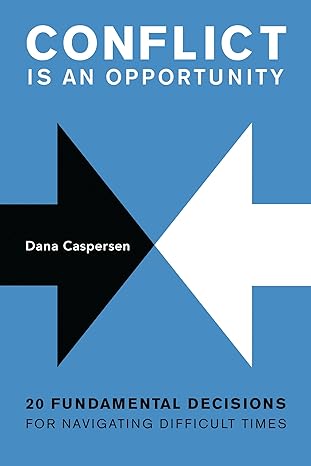
Almost a year ago, I was intrigued by an interview conducted by my friend and onetime USA TODAY/Gannett colleague Deborah Kalb, on her Books Q&A site, with Dana Caspersen, about Dana’s new book Conflict Is an Opportunity: 20 Fundamental Decisions for Navigating Difficult Times.
What struck me in particular was both the theme of working constructively with conflict, and also Dana’s transformation from a distinguished career in the performing arts to earning a master’s degree and subsequently working in conflict studies and mediation, and the author of two books on conflict. As part of my weekly social media sharing of quotes from Deborah’s Q&As, I shared the following quote from Dana: “Our fundamental beliefs about conflict shape what we imagine is possible within it.”
I connected soon after with Dana on LinkedIn, and later edited her article, “The Power Matrix: How Leaders Can Lead Without Coercion,” for the Fall 2025 issue of Leader to Leader, where I am managing editor. I enjoyed working with her on the article, and I’m pleased that she agreed to answer my questions about her multidisciplinary work, background in the arts, and career.
For the non-specialist reader, can you describe the nature of your day-to-day work, including your work with clients, writing, and related artistic endeavors?
I help people strengthen their ability to see the landscape of conflict and take constructive action within it. I work from the premise that our approach to conflict is not a fixed part of our personality, it is the result of what we practice every day. I see this practice as already underway, in how we relate to ourselves and others in the challenges that we encounter. And I find this heartening, because it means that in every instant, we have the opportunity to shape what we practice and by doing so, shape our mindset and the habits that we default to when the going gets tough.
My work has taken multiple forms: individual coaching and group training, where I work with people as they increase their awareness of the choices that they’re making in conflict and their capacity to make those choices consciously; my books, where my goal is to create concise practice tools that are rich with functional information and avoid fluff and jargon; and large-scale public dialogue events, that combine choreographic design and conflict engagement practice to create accessible, impactful ways for people to connect and exchange on difficult topics.
Currently, my focus is on a new program that I have developed for leaders, the Conflict Fluency intensive, which launches in the Fall of 2026. The program brings together a cohort of eight leaders over ten months for in-person retreats, private coaching, and in-depth learning.
How active are you currently in dancing and choreography, and how do these disciplines relate to your work as a conflict engagement specialist? Related to that, ten years ago, The New York Times published a quite positive profile article about you. What effect did that article have on your work and life?
I was a professional dancer and creator for 30 years. Now, the form of that practice has changed for me. As I began my work with conflict engagement, I didn’t understand its connection to dance thinking and tried to keep the two practices separate. Eventually, however, I realized that I had thrown the baby out with the bathwater. Both fields are zones of creative action and active decision-making. To choreograph is to organize ideas physically. To dance is to hold together complex systems and find a line to follow. To work with conflict is to recognize that we are similarly in a space of possibility and that we are shaping that space by how we organize ideas, how willing we are to acknowledge and hold together apparently oppositional ideas and, by doing so, to find a way forward. Now, in my conflict work, both the body and choreographic design are an integral part of the practice— the body as an accurate site of reception and reflection, and choreographic design as a fundamental aspect of how we shape our environments and interactions.
The New York Times profile came at a point when I was wrapping up my dancing career and moving full time into conflict work. It was a great chance to talk about the ways that dance work, with its necessary focus on curiosity, daily practice, and transformative outcomes influences my work in conflict.
Your TEDx talk mentions people’s “approach to conflict,” “mindset and process,” and the concept of “productive conflict.” Can you briefly elaborate on this terminology?
We always, already have an approach to conflict—a way that we tend to respond in challenging situations. Sometimes these habits are so ingrained that they feel like they’re permanent, but they’re not. Similarly, in our interactions with people we have processes in place, consciously or unconsciously, for how we deal with conflict—our collective habits of response. What’s helpful for me is to realize that habits are just what we’ve done the most in the past, so we can change them. We can build new habits. In working with that change, what we are doing is actively shaping our mindset—how we focus our attention internally before we take any action in the outside world.
Conflict can become productive when we recognize that through its dynamic disruptions, every conflict is actually proposing constructive change. People get into conflict because they care about something. When we find out what that is, express what matters to us, and strengthen our curiosity to hold those apparently opposing forces together, we are much more likely to be able to find a constructive way forward that works for everyone and makes life better.