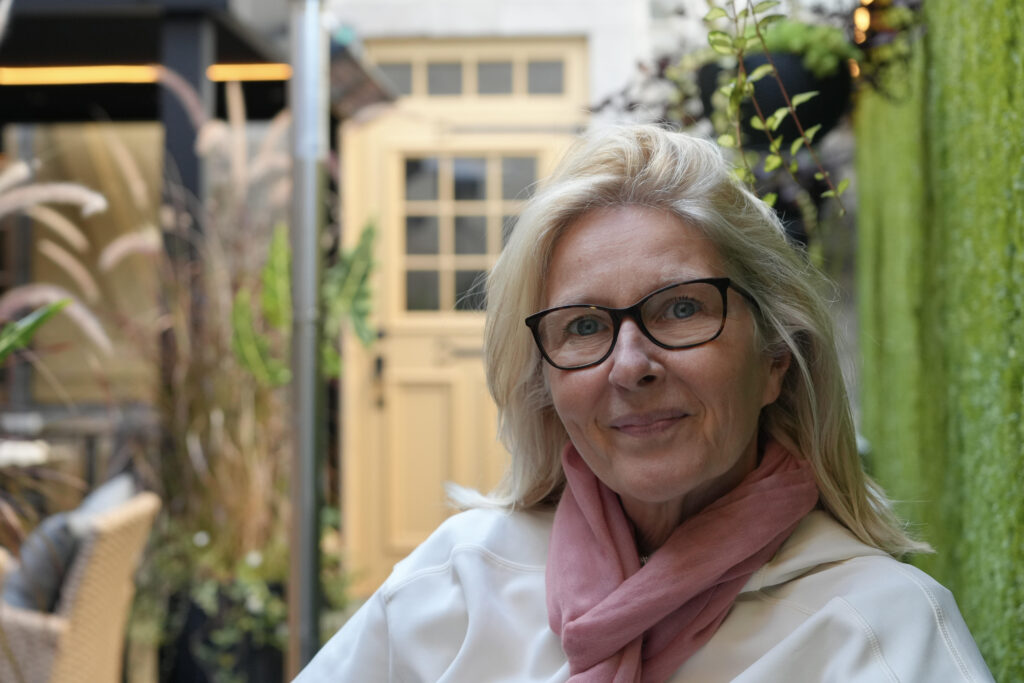
Last year, Zurich-based Nicole M. Heimann wrote a compelling LinkedIn post announcing that she was stepping away from her longtime role as an entrepreneur and business leader and entering a new chapter in life. I found it especially interesting because I had edited her Spring 2020 Leader to Leader article “Achieving Executive Presence: Integrating The Seven Dimensions Of Leadership Intelligence,” which was a positive, collaborative experience. Nicole had been referred to the publication the year before by our founder and longtime Editor-in-Chief Frances Hesselbein.
Nicole and her husband Han Bullens co-founded The Bullens Heimann & Friends Foundation nine years ago. Besides her work in business, entrepreneurship, coaching, and thought leadership, Nicole was also a producer (along with Han) of The Earned Life, a thought-provoking 60-minute documentary about Marshall Goldsmith (which also features Frances). Nicole appears in the film as a biographer of Marshall.
I’m grateful to Nicole for answering my questions about the recent changes in her life and work, and her plans for the future.
Can you briefly describe the recent major changes in your work life, and how these changes fit holistically into your total life?
After 35 years in business – 25 of them as an entrepreneur – I made the deliberate decision to close a meaningful chapter of my professional life. I stepped away from my role as executive coach and mentor and transferred ownership of our firm to my partner, trusting it would continue in capable hands. This decision came from deep realignment.
At this stage of my life, the more relevant question is no longer, “What else can I build?” but “How do I want to live?” That shift reframed everything.
My work today is quieter. I advise selectively and often in the background. I am drawn to depth rather than scale, to meaningful conversations rather than momentum for its own sake. This change reflects a deeper commitment to living in alignment with what matters most to me now: love, family, health, presence, contribution, and growth. For years, I encouraged leaders to live and lead authentically. I am holding myself to the same standard. This chapter feels less like stepping away and more like choosing consciously rather than continuing by default.
Do you consider your current stage of working a reinvention, or have you reinvented yourself in the past?
If I look at my life through the lens of identity, then yes, I have reinvented myself more than once. The first time I consciously encountered the loss of identity, I was 27. I had left my corporate role in the chemicals industry, moved countries, and suddenly the sentence that had defined me – “I am a Key Account Manager”- was no longer true.
I noticed something unsettling: I kept speaking about myself in the past tense. “I used to be…” That experience forced me to confront a deeper question: Who am I beyond my role? When you step out of an identity, you don’t only lose a title. You lose what gave you meaning. You often lose parts of your network, too. Relationships that felt like friendships sometimes reveal themselves as alliances. When the role disappears, so does the glue that holds certain connections together.
That experience made me aware of how tightly we fuse who we are with what we do. About two years later, as I built my own business, identity became a conscious creation. I evolved from trainer to executive coach to trusted advisor to CEOs and boards. Each step required growth – and positioning. In business, identity matters. It creates clarity and trust. But I had learned something essential: identity is a construct. Useful. Necessary. Authentic. Powerful. And still a construct.
So when I stepped away from my professional role, it did not feel like rupture. I knew I was not my title, my business card, or my awards. I am my essence. My energy. My way of seeing and being. I am who I am – with or without titles. From the outside, it may look like reinvention. From the inside, it feels more like remembering – and allowing other parts of me to emerge.
How would you characterize your current/recent work, as well as future aspirations, in areas such as teaching, mentoring, stewardship, and legacy?
If I look at the arc of my life, a thread becomes visible: integration.
When I wrote the book How to Develop the Authentic Leader in You, my work centered on helping leaders align inner values with outer action. That essence has not changed. What is changing is the form through which it seeks expression.
Throughout my professional journey, my connection to nature has always shaped how I led and coached, and how we embodied our values through our foundation’s work in the Amazon Sacred Headwaters region. What is shifting now is not the essence, but the expression: nature itself is becoming the path.
I feel drawn toward the art of Ikebana, which I am studying as a beginner in the tradition of Ikenobō, the oldest school of Ikebana in Japan.
In this practice, I encounter silence and communion. I learn harmony through asymmetry, through emptiness, through seasonality. Ikebana embodies sophistication through simplicity, a discipline of “less is more.” We are not arranging flowers; we are creating space.
Through working with nature, I reconnect with my own inner nature. There is a quiet depth of healing in this process, an integration I can feel more readily than I can yet articulate. It is almost like a moving meditation: an embodied dialogue between form and emptiness, structure and aliveness.
Intuition and contemplation were always central to my coaching work. What is new is that they are now expressed through form rather than conversation. This gives room to an artistic dimension of myself that previously had little space to unfold.
This is not reinvention.
It is not abandoning one path for another. It is making space for a part of me that has been waiting.
In the past, I worked with adults who had lost connection with themselves within corporate systems often designed to reward performance and ego. Today, I sense that disconnection begins much earlier. Young people are growing up in a world that is faster, more digital, and more demanding than ever before.
I hold a quiet vision of working with young people when I am ready to transition from student to teacher, using art to nurture integration early rather than repairing disconnection later. The core remains the same: helping human beings remember who they are.
For now, my task is humility, to be a student, to deepen, to listen, and to learn. I am following an energy that feels grounded and true, trusting that life will reveal when and how this next expression is meant to serve.