
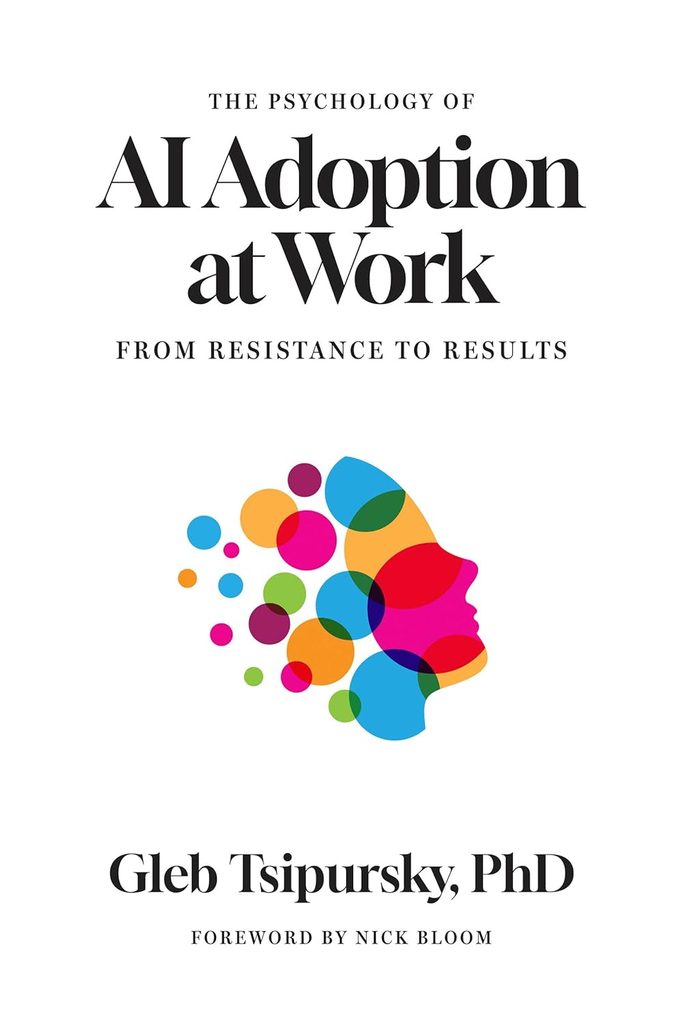
This is publication week for Dr. Gleb Tsipursky’s The Psychology of AI Adoption at Work: From Resistance to Results, published by Georgetown University Press. It is the eighth book in his prolific career as CEO of Disaster Avoidance Experts; writer, podcaster, and former university professor. He writes the Wise Decision Maker Guide newsletter on LinkedIn, which is related to his podcast.
Gleb says that he “now focuses heavily on helping organizations move from AI experimentation to measurable adoption in everyday workflows, drawing on my background as a behavioral scientist and more than 20 years of consulting and training.” On September 1, Harvard Business Review published his article “Middle Managers Will Make or Break AI Adoption.”
The book demonstrates that while artificial intelligence, particularly Generative AI/Gen AI is a complex, ever-changing subject with multiple ramifications inside and outside the workplace, managers and leaders are responsible for how it is used organizationally on a daily basis. And while technical matters remain important, the wise use of AI is strongly influenced by psychology.
Harvard Business School Novartis Professor of Leadership and Management Amy C. Edmondson, probably the most prominent name in the field of psychological safety, endorsed the book: “…Tsipursky translates behavioral science and real-world cases into practical guidance to help organizations experiment boldly, reduce risk, and build the trust and psychological safety people need to embrace AI as a partner in their work rather than reject it as a threat.”
Beyond that endorsement, I was also impressed that the foreword is written by Nick Bloom, William Eberle Professor in the Department of Economics at Stanford University, whom I have often seen referenced in The Economist.
In my role as managing editor of Leader to Leader, I’ve worked with Gleb on two articles: “The Importance of a Tailored Hybrid Work Model Decision Framework For Different Departments and Roles,” (Summer 2023); and “How to Do a Strategic Pivot to Address External Disruptors,” (Summer 2021). I’ve always found him to be highly collaborative, focused, prompt, and responsive to making changes to his articles when necessary.
I’m grateful to him for answering my questions about his new book, his career, and how AI can be adopted successfully in the workplace.
For the non-specialist reader, how would you characterize the research findings, and lived experience behind your new book, The Psychology of AI Adoption at Work?
For a non-specialist reader, I would describe the book as combining behavioral-science research with what I have seen over more than two decades of consulting and training, along with 15 years in academia. The recurring pattern is that resistance to AI often comes from perceived threats to competence, autonomy, status, fairness, and job security, compounded by uncertainty about how decisions will be made. Adoption improves when leaders give people clear guardrails, agency, psychological safety to experiment, practical coaching, and visible examples of how AI helps with real work. That is why I treat AI adoption primarily as a human behavior and organizational change challenge rather than a software rollout.
You were featured and quoted extensively in “The R.T.O. Whisperers Have a Plan,” an April 11, 2023 article in The New York Times. How did this major exposure affect your career, and your presumably greater visibility after it was published?
The New York Times feature expanded the visibility of work I was already doing and gave people a memorable shorthand, “Office Whisperer,” for my work on difficult workplace transitions. It also reinforced a lesson that carries directly into AI adoption: leaders make more progress when they treat workplace conflict as a behavioral and decision-making problem that can be managed, rather than forcing people into rigid camps.
Given that AI is such a moving target and an ever-changing subject, are you at all concerned that your book may need to be updated in the near future; or does the psychological aspect (especially about uncertainty and fear of losing jobs and professions) mean it is unlikely to lose its relevance?
I expect the tools, model names, and specific examples around AI to keep changing quickly, so those surface details will age. The psychological mechanisms move much more slowly. Loss aversion, status quo bias, uncertainty, social identity, concerns about competence and job security, and the need for fairness and control will remain relevant even as the technology changes. That is why the book centers on the human adoption process and uses the technology as the context. Future editions can update examples without changing the core framework.