
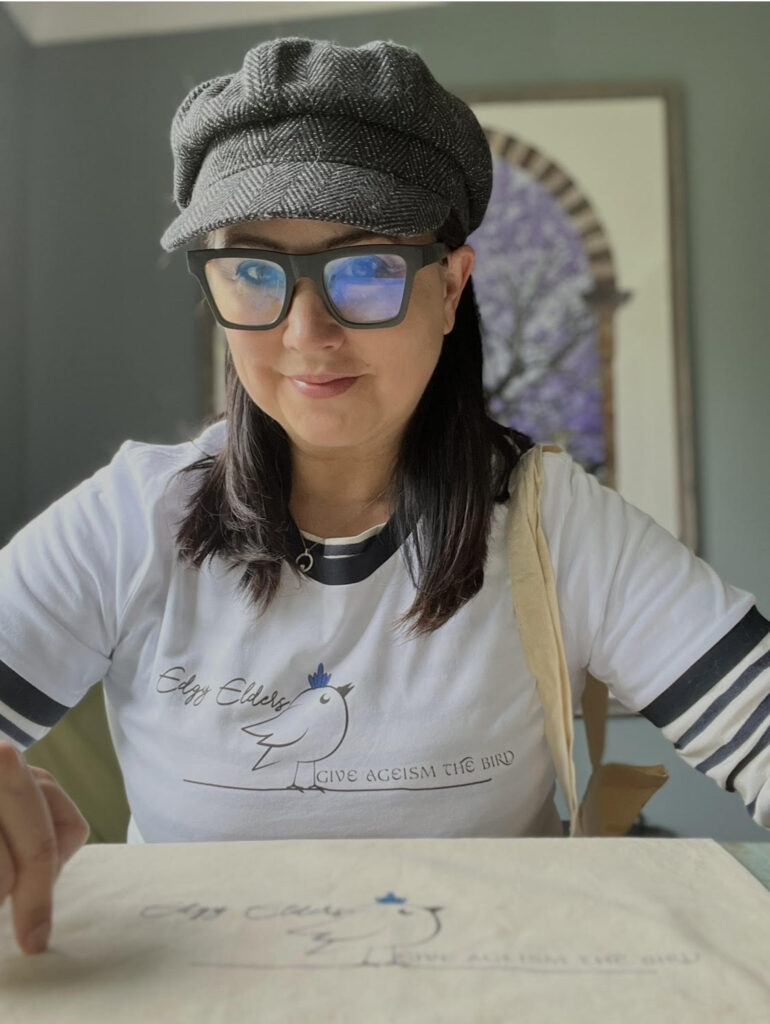
The work and career of the Australia-based researcher and lecturer Natasha Ginnivan is amazingly multidimensional and varied. As you will see in the Q&A below, Natasha applies intense curiosity and scholarship to a variety of subjects; especially health, mental health, aging and wellbeing; treating them in kaleidoscopic ways in her writing, teaching, and related activities.
I’m grateful to Natasha for answering my questions about her life and work, especially as it relates to a number of different strands and subsets of aging and longevity, and thriving in the second half of life.
For the non-specialist reader, how would you characterize your aging-related work; including writing, researching, and teaching; and how it all fits together on a day to day basis?
My aging-related work stems from a PhD thesis that I published exploring cultural attitudes to aging. In particular, I was curious about researching age stereotypes, internalised ageism and a phenomenon known as stereotype threat. Stereotype threat, coined by Dr. Claude Steele, is the fear of confirming a negative stereotype about a social group (e.g. gender, race or age) to which one belongs.
Studies on stereotype threat found that those confronted by this phenomenon became anxious, have self-doubt and became fearful of being judged by others. In turn, this tends to drain memory and can hurt performance – whether it is at work, on tests or in job interviews.
I have researched ageism for some time and I was funded in part to work on projects that addressed the types of interventions that might reduce ageism, in particular in the workplace. I would apply for small pots of funding and draw together people for age-diversity conversations or special interest groups on ageism where we would view films such as Golden: The End of Ageism, or discuss ways of combatting ageism.
There wasn’t a huge amount of funding for ageism research, so I scoped out other topics of interest which included aging in marginalized populations. After seeing a documentary and reading a piece inThe New York Times about aging prisoners, I sought out funding to research this growing issue in Australia.
I was funded by the Centre of Excellence in Population Ageing Research (CEPAR) to do a scoping review on the demographic shift of the prisoner population in Australia and published a few articles on this topic. From this work, I had the opportunity to present my research at the Oxford Institute of Population Ageing in 2017, and in 2018 I was invited to present my research on aging prisoners at the Institute for Crime & Justice Policy Research in London.
I am currently an Adjunct Lecturer at the School of Population Health, University of New South Wales Sydney; and I hold an administrative type of role in local government as my ‘day job.’ However, because I am so enthusiastic about pushing back on ageist narratives and disrupting ageism, I blog on the weekends on all manner of topics to do with ageism and self-perceptions of aging and I also run a weekend market stall called Edgy Elders. I have an online store with the same name as part of my blog Mobilising Wisdom – it’s mostly a side hustle activity when I have time.
To answer your question about how it all fits together – I sort of make it fit together. My day-to-day work does not readily facilitate my writing about aging at the moment. I tend to only write in my downtime on weekends or during holidays, but I am determined to disrupt age stereotypes and having come from an early career in design, I still have an impulse to express this creatively with my blogs, designing a small line of product and my market stalls.
I’ve read that you are an alum of Chip Conley’s Modern Elder Academy. Can you describe the experience, including your interactions with Chip, and relate briefly how all of that has affected your life and work?
I have to say that my MEA Alum status relates only to having completed the online courses offered to midlifers by MEA Wisdom. I took an online course with MEA at the beginning of covid during lockdown. Until very recently, I have had parenting and work responsibilities that precluded me from flying over to Baja, Mexico or Santa Fe campuses – although I would love to go one day in the future.
I have therefore never actually had the honour of meeting Chip in person. However I have had Zoom conversations and communicated via email regarding my guest posts that Chip kindly publishes in his MEA blog, Wisdom Well. I have also had the pleasure of interviewing Chip for my blog about his book Learning to Love Midlife:12 Reasons Why Life Gets Better With Age.
Chip is such a generous soul who really sees the good in everyone. Where he is able to, he uplifts and contributes to the work of others despite being so busy and having openly shared some of his recent health challenges. Recently I heard from a budding filmmaker, Ilise Harris, who had made a film about women ‘ditching the dye’ called Your Roots Are Showing. Chip invited Ilise to be a panelist at the MEA Film Festival as a platform to speak about her film. I wrote a blog piece about the film, which she made solely with her iPhone, and I’ll be publishing another piece soon about her journey since then. Ilise described Chip as a ‘lightworker,’ due to his kindness and soulfulness.
I found this was a great description of Chip, because from the moment I reached out to him back in 2018 after I’d read his book Wisdom @ Work: The Making of a Modern Elder, he was very friendly, open and directed me to a group of Australian MEA Alums. Some had travelled and undertaken courses in Baja and Santa Fe and others, like me, had just taken the MEA courses online.
Along with other Australian groups of MEA Alums I have maintained contact with Chip, and he has always been very supportive of any topics I was keen to publish, like how the need for more creativity re-emerged in midlife for me.
From your research, work, and lived experience; what are some commonalities and differences regarding the second half of life for people in Australia, where you are based, and in other countries?
What I know from my research on ageism is that a large World Health Organization study shows that one in every two people across eighty countries show moderately to high levels of ageist attitudes toward older people. There appears to be many drivers of ageism. However, it cuts both ways, and younger people can also be unfairly discriminated against due to their age.
Even as I was studying ageism, I’ve experienced different forms of ageism myself in personal and working relationships. Ageism manifests in subtle ways at work, like only being offered part time roles, and then being asked to complete the equivalent of a full-time workload.
In addition, there were things like being asked to do favors like picking up your boss’ kids from afterschool care because he had a meeting that he could not miss. I believe this is something that would rarely, if ever be asked of my younger male colleagues who were only ever offered fulltime roles to be able to complete their research. I think this stems from a cultural perception that women over forty or fifty are somehow ‘less valuable.’
Men experience ageism in the workplace too, but it likely shows up in their late fifties and sixties in different ways. In fact, according to ILOSTAT data, Australia ranked the highest among 102 countries for discouraged jobseekers 65 and over. This is despite the Australian government increasing the retirement age to 67 in July 2023, which makes things challenging for maintaining employment or earning some kind of livelihood.
There is some change in the wind with the Australian Government recently expressing support for the proposed UN Human Rights of older persons. In 2022, I had the opportunity to address the UN Multistakeholder meeting in Geneva to convey how significant the role of global media is in promulgating negative attitudes. Unfortunately negative attitudes and age stereotypes persist in the media.
In my own small way, I continue to publish and highlight ways that casual and everyday ageism manifests, such as benevolent ageism, where older people are pitied or objectified for appearing ‘old and lonely.’ For example, in overt or faux performative displays of ‘kindness’ on social media.
I think that my personal stories and the wider research on ageism in the workplace are common globally. Though, some countries attempt to ‘bake in’ support for older persons in work and their living programs. For example, German research on age-diverse groups in workplaces found that multigenerational teams can yield better results than same-age teams (all younger or all older), though there are optimal conditions for yielding such outcomes.
I was involved in some local research on barriers and enablers to a multigenerational workforce led by my colleague, Dr. Catherine Rickwood. The project found that in order for workplaces to embrace age-diversity it is essential that senior executives and managers know what’s required for older and younger workers to effectively and harmoniously work together for individual and collective benefit. Although these were our findings on this particular study, in my view very little attention or resources go into combatting ageism in the workplace.
Further afield in a different setting, Dutch care homes introduced free accommodation to students in aged care to improve socialisation in exchange for students spending a certain amount of time providing companionship to the older residents.
Other countries in Europe, Asia and Africa may have a higher degree of intergenerational families who are more interdependent than in the West. This doesn’t guarantee that ageism doesn’t exist in these countries, however, some research shows that there are more positive attitudes to older folks and one’s own aging when there are closer intergenerational ties. This is likely because people would have a realistic representation of what ‘older’ looks like rather than relying solely on ideas built on negative age stereotypes.
If I had funding for aging research and programs I would promote as many intergenerational-based programs as possible with the appropriate background checks and supervision to ensure responsible child safety frameworks are in place. Having grown up in a cross-cultural family, I believe my desire to advocate for older people stems from always having aunties, older cousins and grandparents around.
When delivering the final presentation of my PhD, I reflected on the positives of intergenerational connection, and had the permission of filmmakers to show the trailer of their film about this topic, The Growing Season. The trailer starts with the Zulu quote ‘a person is a person because of people.’ I think people have much to offer one another throughout the life course and not just when we are younger. As the theorist Erik Erikson once reflected, “In a family where the old do not fear death, the young do not fear life.” I think that some cultures do a better job than others of keeping their kin (old and young) close, and are not afraid to say farewell to them when the time comes. My view is that aging is just another word for living, and not something to be feared or ashamed of.