
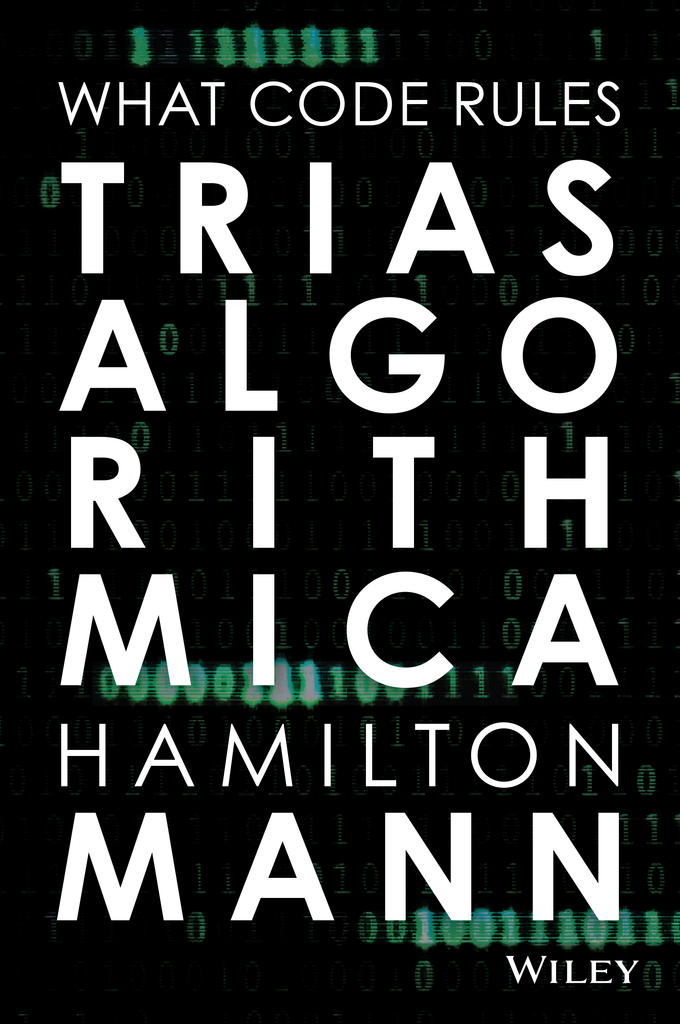
Hamilton Mann, Chairman and President of the Artificial Integrity Institute, is one of the most original thinkers in the AI space. Among other things, he is also Visiting Scholar, The Wharton Neuroscience Initiative, The Wharton School, University of Pennsylvania. I am following up my January 13, 2025 blog post interview with him with this interview marking the publication of his new, second book, Trias Algorithmica: What Code Rules.
The book, like his first, Artificial Integrity: The Paths to Leading AI Toward a Human-Centered Future (2024), is published by Wiley, the co-publisher of Leader to Leader, the quarterly journal where I am managing editor. I’ve had the opportunity to work with him four separate times for the journal, editing his articles “Transferability: An Enduring Leadership Skill in the Age of Intelligence Transformation” (Fall 2026), “Escaping AI Productivity Traps: A Leadership Playbook for Artificial Integrity” (Spring 2026), “Building an AI Compact to Uphold Artificial Integrity” (Fall 2024), and interviewing him for our ‘From the Front Lines’ article “Technological Stockholm Syndrome: What it Means, and Why it is Important” (Fall 2025).
I’m grateful to Hamilton for answering my questions about his new book, research, and work related to topics that are of such crucial importance in the world of today and tomorrow.
How would you characterize the research and key messages represented in your new book Trias Algorithmica: What Code Rules?
My new book deals with a subject that is sometimes taboo. That of power. And more particularly that of algorithmic power and its extreme concentration in some of the systems we use, whether privately, in business or even at the level of states. After having written about the need for artificial integrity, a concept that goes beyond the very notion of the alignment of AI systems with specified goals, intentions or values to address their capacity to behave with integrity in light of the ethical, moral, and social implications of their outcomes, I turned my focus to the legitimacy of the power exercised by algorithmic systems, examining a question that we ask far too rarely: what makes algorithmic power legitimate?
In any human organization, this question is at the heart of the system of interrelations and therefore interactions, because it de facto necessarily implies a distribution of power.
What we call governance serves precisely to characterize the structure of that distribution, and history has taught us one thing in this regard: no power should ever become so concentrated that it can simultaneously establish what must be done through rules of any kind; ensure their proper implementation and enforcement; and assess its own adequacy, its own compliance, or even the acceptability of its own results against the very rules it has itself established, whether regarding its own exercise of power or its consequences for those subject to it.
This separation of powers is consubstantial with its legitimate exercise. Except that we have recreated this pattern of concentration of power in some of the algorithmic systems we use, which possess at the same time a normative power, similar to legislative power, through the rules they induce and that shape our behaviors and our ways of thinking; a power of action, which differs little, if at all, from executive power, whose autonomy is increasing, particularly with AI agents, and a power analogous to an authority of judgment and therefore quasi-judicial, when certain AI outputs stand as the sole possible outcome of reasoning, assessment or interpretation. In this book, I wanted to draw attention to this reality, often ignored, analyze the source and the mechanisms of this new power that I call the sixth power, examine the causal relationships and consequences we can observe at the individual, economic and societal levels, and propose an approach to achieve what I call the separation of algorithmic powers.
Does the book (or do you separately in your work and teaching) address the ‘existential’ fears people have regarding AI?
My book does not address the subject in the terms recently used around the fear of the annihilation of humanity, if that is what is being referred to. For my part, I also find this way of framing the debate somewhat restrictive, not to say confiscatory of the distance necessary for objectivity and reflection. When we use words that activate imaginaries of an existential threat and imminent catastrophe, this generally leaves too little room for critical judgment, giving way instead to an “automation” of defensive reflexes and behaviors.
Instead, in Trias Algorithmica, I have tried to address our capacity for critical thinking, sometimes describing the stages that unfold almost inevitably under a certain degree of exposure to algorithmic power, one of these patterns I chose to call the Technological Stockholm Syndrome, which I had already written about in Leader to Leader; and sometimes also taking a step aside to look at what our economic history, or even parts of the history of human civilization, can help us understand, in order to help decode certain preconceived ideas served to us as ready-made ways of thinking.
Above all, I wanted to remain as close as possible to the description of certain mechanisms that reflect what we can experience and feel in our relationship with algorithmic power, which changes our perceptions, and therefore our certainties, about ourselves, about others, and even about what we thought we could take for granted. All of this generates fears that should not be overlooked and that are useful to examine because they are part of the effects caused by algorithmic power; effects that we need to understand in order to define what must be operationalized for the separation of algorithmic powers and the appropriate counterpowers to take place in this algorithmically mediated life we now live. This is the path of analysis and research that I develop in Trias Algorithmica.
Among the target audiences for the book are business leaders and policymakers. How much prior knowledge and experience do these non-specialists need to already have to fully understand your concepts?
The book develops and evolves over the course of its chapters through perspectives that are at times technological, economic, sociological, or even political, at times flirting with implications of a psychological nature, to which are added a few historical steps aside, an anthropological and philosophical perspective, and perhaps even a slightly poetic one. It is therefore a book that may seem difficult to classify; also because the world we live in allows less and less for the effective application of monolithic frameworks of interpretation or monodisciplinarity. That being said, I also wanted Trias Algorithmica to be approachable without the burden of presumed prior expertise. Because the question of the separation of algorithmic powers is one of those that, I believe, carries an essential, universal and urgent stake for us all.